


I often find myself marveling at the patience and forbearance our parents have shown in so many aspects of raising us. No, this isn’t another long bout of introspection — though it’s amusing that it has taken me so many years for this realization to truly sink in I say this as I try, somewhat tentatively, to recreate what my mom (Amma) would have done on this special day for the very endearing, elephant-headed deity, Ganesha.
Growing up, Amma never missed marking an important festival. Every occasion was celebrated with the perfect altar, mouth-watering delicacies, carefully chosen clothes, and a traditional lunch or dinner. I, of course, enjoyed the food and the finery, but I never really attempted to learn or emulate what she did. I’m not sure if that was ignorance, quiet rebellion (in my own subtle way), or simple nonchalance. And since my parents still live with us for the most part, I’ve probably been spoiled even further, continuing to rely on Amma to mark these occasions in her own inimitable style.
This year, though, has been different. Not only have we moved a gazillion miles from the US to Singapore, but my parents are now making more frequent trips back to India. Which means I finally have to fend for myself I’ve never been one to do anything elaborate on festival days. A “celebration” usually meant singing a special song for the deity, or occasionally visiting a temple — if at all. And that generally happened only if Amma or my mother-in-law gently reminded me a week before… or repeatedly… or at least the evening before.
This year, that’s changed too. Maybe it’s because I’m still “settling in” and not working (yet), or because, as Amma puts it, “you have more time now, you should finally try.” I could go on about why I don’t feel the need to celebrate festivals in a big way, or why every day should be the same, or question why we pray more on certain days than others — blah, blah. This is usually the point where I should stop being overly philosophical.
Because here’s the truth: when I did go the extra mile this year, when I tried to recreate even a small part of what Amma would have done, when I made some of the traditional prasadam for Ganesha, and when I said that extra prayer this morning — it felt different. In a good way. There was a vague sense of fulfillment, and that elusive feeling that Nikhil describes so perfectly: “It feels peaceful in my brain.” There. I said it.
That said, it is hard work. I made kozhakattai or modak (steamed dumplings with sweet and savory fillings) successfully for the first time. The last time I tried, they crumbled and looked more like amoebas than offerings. I barely scratched the surface of what Amma would have done to make this day special, and honestly, I was exhausted by the end of it. Which brings me right back to that thought about our parents’ patience and forbearance.
Here’s the recipe — adapted from Festival Samaiyal by Viji Varadarajan.
Kozhakattai (Modak)
Dough / Dumpling Base
Ingredients
- Rice – 2 cups (I used basmati)
- Water – 4 cups
- Milk, lukewarm – 1 cup
- Salt – a pinch
- Sesame oil – 2 tbsp
Method
1. Soak the rice in 2 cups of hot water for about 20 minutes.
2. Grind the rice to a very fine paste, adding a little water as needed.

3. Add the milk, salt, and oil to make a very thin batter.
4. Heat a heavy-bottomed pan and lightly grease it. Pour in the batter and cook on medium heat, stirring continuously for 5–7 minutes. The mixture will thicken and begin to cling to the ladle and roll around it.
5. Remove from heat and transfer to a wide dish.
6. Grease your hands lightly and knead the dough well until smooth and lump-free. Cover with a damp cloth and set aside.

Sweet Jaggery Filling (Thengai Poornam)
Ingredients
- Grated coconut – 2 cups
- Jaggery or palm sugar – 1 cup
- Cardamom powder – 1/2 tsp
- Water – 3/4 cup
Method
1. Melt the jaggery in a heavy saucepan, adding water if needed.
2. Add the grated coconut and cook on low to medium heat, stirring continuously.
3. Once the moisture evaporates, add the cardamom powder.
4. Continue stirring until the mixture becomes sticky and fudge-like.
5. Cool slightly and shape into small lime-sized balls. Set aside.
Savory Filling (Uppu Kozhakkattai)
Ingredients
- Urad dal (black gram) – 3/4 cup
- Green chilies – 4
- Asafetida – 1/3 tsp
- Mustard seeds – 1/4 tsp
- Salt – 1/2 tsp
- Chopped curry leaves and cilantro (optional) – 1 tsp
- Oil – 1 tsp
Method
1. Soak the urad dal in 2 cups of hot water for 20 minutes. Drain and grind to a very coarse paste with chilies, asafetida, and salt.
2. Steam this mixture in a pressure cooker for 7–10 minutes.
3. Cool and crumble it with your fingers or a fork until it resembles coarse crumbs (usuli).
4. Heat oil in a pan, add mustard seeds, and once they splutter, add the usuli. Mix well and add curry leaves or cilantro if using.
5. Set aside to use as the savory filling.

Assembling the Kozhakattai
1. Grease your hands lightly and form lemon-sized balls from the dough. Shape each into a small cup or boat. For savory kozhakattai, flatten the dough into a disc.
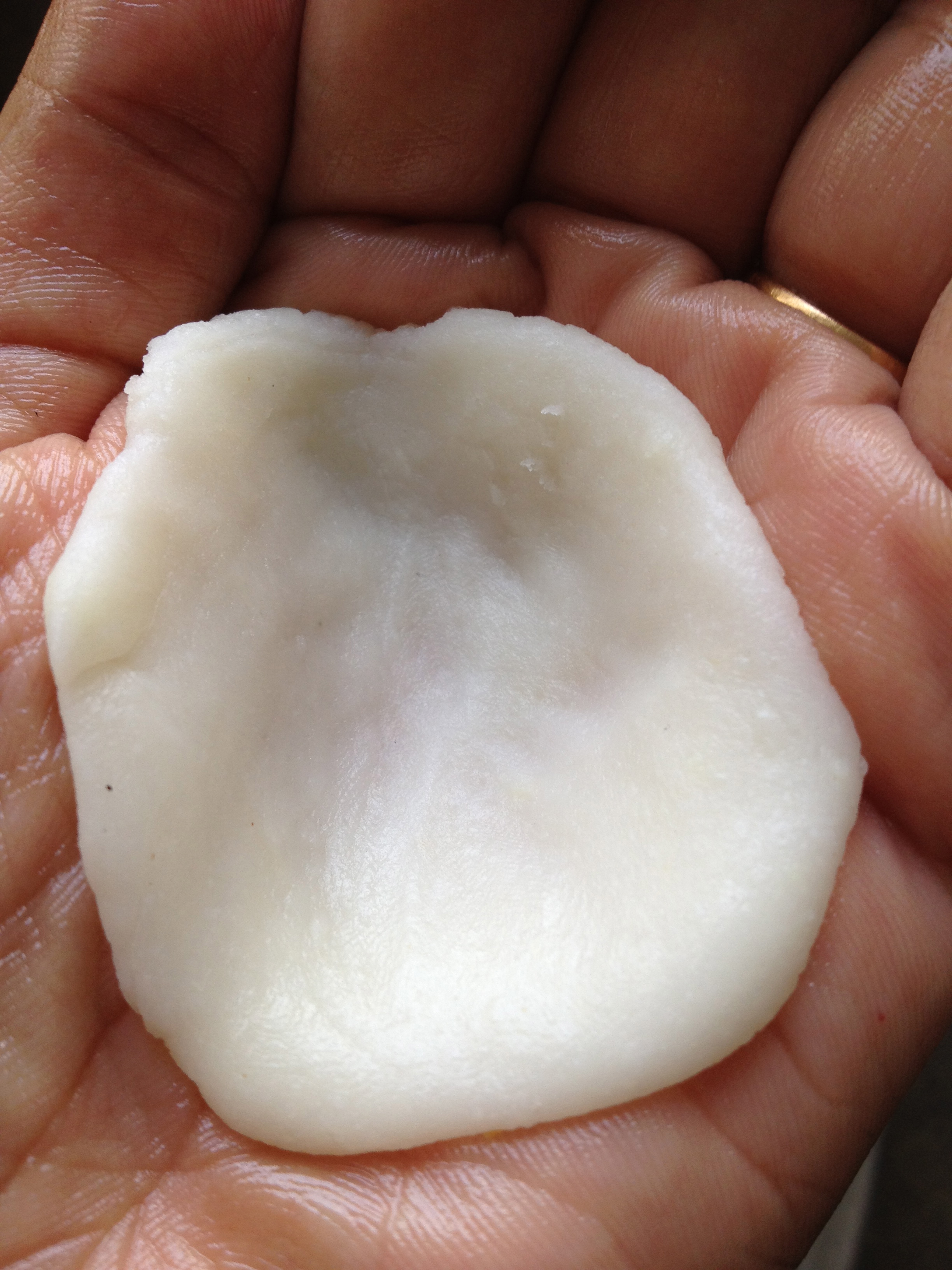
2. Place the sweet filling in the center and gently bring the edges together to form a round dumpling with a small peak.

3. For savory ones, place the usuli in the center and seal to form a crescent shape.
4. Steam both sweet and savory kozhakattais in a steamer, idli cooker, or pressure cooker (without weight) for 7–10 minutes. You’ll see tiny beads of moisture on the surface when they’re done. Undercooked kozhakattais will feel sticky.



Hey Malini…lovely article..could relate to every alphabet of it! Happy ganesh chaturthi..see you tom;rrow. Vidhya
Thanks Vidhya – I guess you were blessed this year to have both your moms together to make this Ganesh Chaturthi special:) What other specialities did you make? I need to visit when they are both here to capture some of their specialities.
Happy ganesh chaturti malu, Mom and dad are here this yr, mom is of course bored out of ther mind 🙂 how are you enjoying s’pore especially the staying at homepart, ripping your hair out or enjoying it ?
SO this yr i was spared making modaks, usually my pune based MIL gives me many heads ups…which i routinely ignore and then end up making last min modaks , you should get one of those molds from india very easy to make and looks so professional.
They are leaving tomorrow. and dad tells me he can’t believe he raised me, especially the part of me that has turned into a feminist and according to him a hippy 🙂 ( just because i told him i was perfectly fine with my kids not marrying and living with someone) , of course since narayan and his wife live with them, i have been lecturing them incessantly on the meaning of “SPACE” – so dad now starts nodding nad says yes yes i will give space while mom mumbles ” nala galam unnoda illeye”
has been an interesting 3 months. 🙂
Hi Myth – so good to hear from you. Happy Ganesh Chaturthi! Say hi to your parents for me. Will send you a longer note on your gmail:)
Ok Malini, I was bored at work and all of a sudden remember to browse thru Roz ka khana to see if you have posted any thing new. I must say i feel like going home and try all your new recepies. I just had lunch but i am hungry again 🙂
Thanks for sharing all your recepies!